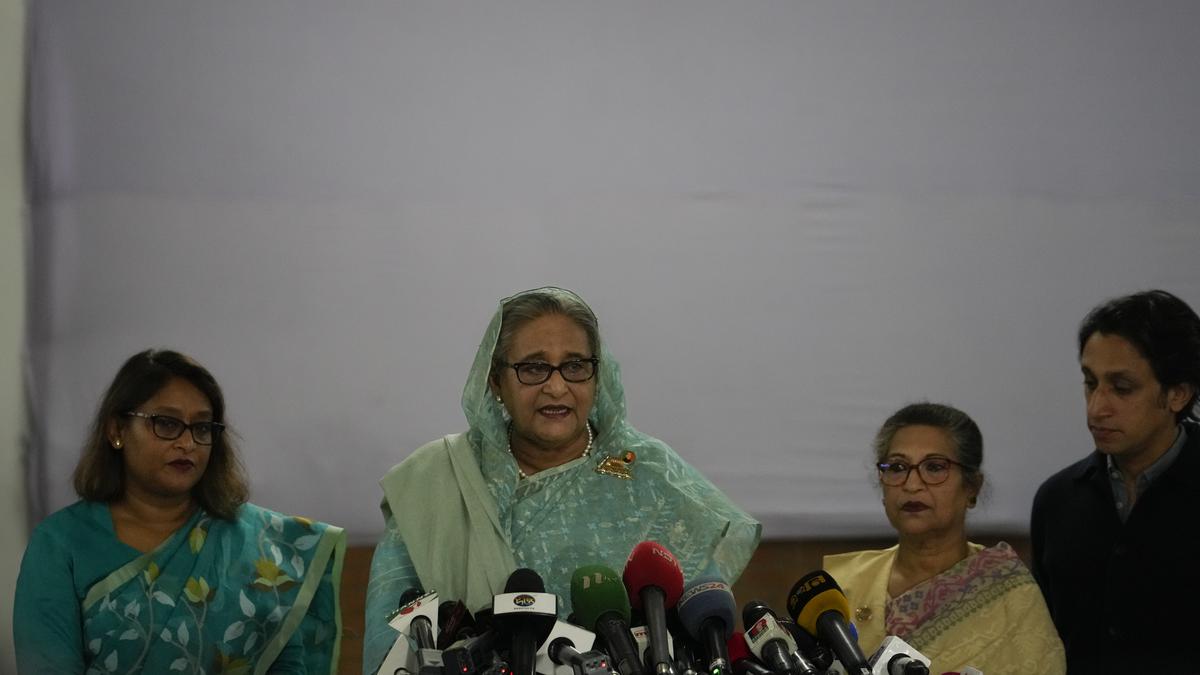
Bangladesh Prime Minister Sheikh Hasina, centre, is flanked by her daughter Saima Wazed Putul, left, sister Sheikh Rehana, second right, and her nephew Radwan Mujib Siddiq Bobby, right, as she speaks to the media persons after casting her vote in Dhaka, Bangladesh on January 7, 2024.
| Photo Credit: AP
Bangladesh was voting on January 7 in an election guaranteed to give a fifth term in office to Prime Minister Sheikh Hasina, after a boycott led by an Opposition party she branded a “terrorist organisation”.
Ms. Hasina has presided over breakneck economic growth in a country once beset by grinding poverty, but her government has been accused of rampant human rights abuses and a ruthless Opposition crackdown.
Her party faces almost no effective rivals in the seats it is contesting but has avoided fielding candidates in a few constituencies, an apparent effort to avoid the legislature being branded a one-party institution.
The Bangladesh Nationalist Party, whose ranks have been decimated by mass arrests, has called a general strike and urged the public not to participate in what it calls a “sham” election.
Also Read | Bangladesh’s growing political personality cult around ‘Father of the Nation’
But Ms. Hasina, 76, called for citizens to cast their ballots and show their faith in the democratic process.
“The BNP is a terrorist organisation,” she told waiting reporters after casting her vote.
“I am trying my best to ensure that democracy should continue in this country,” she added.
Polls will stay open until 5:00 p.m. local time (1100 GMT), with results expected after midnight.
‘Farce’ election
Early signs suggested turnout would be low, despite widespread reports of carrot-and-stick inducements aimed at bolstering the poll’s legitimacy.
Two hours after voting began, only 111 people had cast ballots out of the nearly 4,200 registered at one polling station in Dhaka’s west, presiding officer Prashun Goswami told AFP.
“I don’t have any interest in participating in this farce,” charity worker Shahriar Ahmed, 32, told AFP.
“I would rather stay home and watch movies.”
Some voters said earlier they had been threatened with the confiscation of government benefit cards needed to access welfare payments if they refused to cast ballots for the ruling Awami League.
“They said since the government feeds us, we have to vote for them,” Lal Mia, 64, told AFP in the central district of Faridpur.
The BNP and other parties staged months of protests last year, demanding Ms. Hasina step down ahead of the vote.
Around 25,000 Opposition cadres including the BNP’s entire local leadership were arrested in the ensuing crackdown, the party says. The government puts the figure at 11,000.
Small and scattered protests continued in the days ahead of the election — a shadow of the hundreds of thousands seen at rallies last year.
On Sunday, police in the port city of Chittagong said they had fired shotguns to break up a rally of up to 60 Opposition members who had blocked a road using burning tyres, adding that no one was injured.
The election commission said nearly 700,000 police officers and reservists had been deployed to keep order during the vote along with nearly 100,000 members of the armed forces.
Politics in the world’s eighth-most populous country was long dominated by the rivalry between Ms. Hasina, the daughter of the country’s founding leader, and two-time premier Khaleda Zia, wife of a former military ruler.
Ms. Hasina has been the decisive victor since returning to power in a 2009 landslide, with two subsequent polls accompanied by widespread irregularities and accusations of rigging.
Ms. Zia, 78, was convicted of graft in 2018 and is now in ailing health at a hospital in the capital Dhaka, with her son Tarique Rahman helming the BNP in her stead from exile in London.
Mr. Rahman told AFP that his party, along with dozens of others, had refused to participate in a “sham election”.
‘Dangerous combination’
Ms. Hasina has accused the BNP of arson and sabotage during last year’s protest campaign, which was mostly peaceful but saw several people killed in police confrontations.
The government’s security forces have long been dogged by allegations of extrajudicial killings and enforced disappearances — charges it rejects.
The United States, the biggest export market for the South Asian nation of 170 million, has imposed sanctions on an elite police unit and its top commanders.
Economic headwinds have left many dissatisfied with Ms. Hasina’s government, after sharp spikes in food costs and months of chronic blackouts in 2022.
Wage stagnation in the garment sector, which accounts for around 85% of the country’s $55 billion in annual exports, sparked industrial unrest late last year that saw some factories torched and hundreds more shuttered.
Pierre Prakash of the International Crisis Group said Ms. Hasina’s government was clearly “less popular than it was a few years ago, yet Bangladeshis have little real outlet at the ballot box”.
“That is a potentially dangerous combination.”
Bangladesh newspaper site blocked
One of Bangladesh’s key newspapers critical of the government said its website had been blocked, as the country votes in a general election boycotted by the Opposition.
Sajid Hoque, news editor at the Daily Manab Zamin, said the paper had been “flooded with calls and messages” from readers who said “that they cannot access our website”.
The newspaper’s printed edition was still available on the streets.
The paper, one of the most popular in the South Asian nation and known for its critical coverage of political affairs, posted on its Facebook page on Saturday that the blockage was not due to “any technical issues” on its site.
“Manab Zamin’s website is not accessible from across the country”, the paper posted.
AFP could not access the website in Dhaka, and Bangladesh internet monitor Activate Rights reported that the site had been offline since Saturday.
International media watchdog Reporters Without Borders (RSF), which ranks Bangladesh 163rd out of 180 countries in its world press freedom index, warned ahead of the vote of what it dubbed the government’s “harmful grip on information”.
#Voters #cast #ballots #Bangladesh #election #marred #violence #Opposition #boycott