“When I am working on a problem I never think about beauty. I only think about how to solve the problem. But when I have finished, if the solution is not beautiful, I know it is wrong.”
— Buckminster Fuller
As a norm I steer clear of united Ireland conversations, not because I’m not interested in the subject (it’s not going away any time soon), but because it is a discourse that quickly slips into the assumption there’s just one community in Northern Ireland.
There’s a practical reason for that, which is less to do with bias and more to do with the fact that the topic only animates interest in a small if passionate a minority of the population, so active participation barely extends to views from outside that minority.
For once I was persuaded to watch a classic debate in the Cambridge Union last night in part because one of the speakers was Malachi O’Doherty. The motion: This House Believes The Time Has Come For A United Ireland.
I hope it doesn’t spoil it for you that the motion was carried by quite some distance. the recorded as live video that this is pretty much where the sentiment lay right from the get go. Those against came below those abstaining.
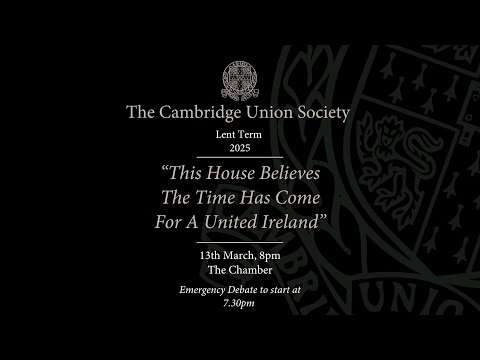
Speakers for included Aoife Moore (link) the journalist and author, Darragh O’Reilly (link) a student from Fermanagh who steeped in for the MP for FST Pat Cullen MP who pulled out at the last minute and fellow student Eibhlinn Hutchinson (link).
Speakers against were Alex Burghart (link), Shadow Secretary of State for Northern Ireland, old friend of Slugger since his days as Fortnight editor Malachi O’Doherty (link), and student Louis Goldberg (link) and apparently regular speaker from the floor.
Although none of the speakers represented the Northern Irish Unionist perspective, the value of this Oxford style debate of a single polarising question means that there are at least two perspectives aired by the two teams if not in the audience.
Those speaking in favour were eloquent and at times highly emotionally charged, but their contributions barely touched upon the substance of the motion itself, but that connected seamlessly with the dominant sentiment within the room itself.
Aoife’s case featured “800 years of history and 27 years of peace”, higher disposable income, more student places and lower fees in the south, and brought the house down with: ‘the English have never left anywhere without being told repeatedly to leave”.
Definitely a crowd pleaser, but it also exemplified a pitch from the pro side that (with the exception of the beginning of Eibhlinn Hutchinson’s presentation) that contained few references to the inconvenient non nationalist majority from consideration.
On the anti side Alex Burghart pointed out that the Belfast Agreement itself (signed up to by all the current parties) means the Secretary of State’s hands are tied: ie the flaw in the proposition is that now cannot be the time because it is not likely to pass.
This was axiomatic to O’Doherty’s argument that we must have a precise context for any proposition going forward. Oddly enough this is the position of the most radical of the main parties in NI, Sinn Féin, which may help explain their MP’s absence.
There was much talk of trauma in the pro side. Moore rightly directed her ire at the trauma of ongoing paramilitary coercive control over working class areas but without explaining how an immediate change in constitutional status would address it.
For such an august institution, there were also some important knowledge deficits. One person in the crowd claimed that recent elections had seen the nationalist vote had reached as much as 52%. If it has, I’ve not see anything near such figures.
It was claimed too that Northern Ireland is the poorest region in the UK, when it has the lowest rates of child poverty. What’s notable is that whilst Catholic social advancement is into its fourth decade, they predominate in the poorest areas.
The stiffest existential challenge facing those impatient for a united Ireland is that 1 in 5 nationalist voters don’t actually favour unification. There is concern too that registration of young Catholics who live in the poorest areas is falling off a cliff.
It came to the last anti speaker, Louis Goldberg, to neatly frame the most pressing qualitative issue both at the opening of his presentation:
There are
30miles of wall in Belfast separating mostly working class Catholic and working class Protestant communities these walls and the hatred, trauma and deprivation behind them concern me a lot more than the checkpoint-free, open border between the Republic and the north.
And towards the end…
…while sectarian inequality is falling general wealth inequality is rising. I’m not theoretically against a united Ireland, but I see the project as a nationalist distraction. There is a delicate balance which allows a borderless island while Northern Ireland stays within the UK. A united Ireland will not heal the wounds of the past.
It will likely reignite the conflict. While most do not want this, I think some either consciously or unconsciously [do], their sense of personal and communal identity is bound up in the Troubles. This is completely understandable, but the human tendency to repeat past traumas must be resisted in favour of healing.
He then concluded with the most compelling thought in the whole debate:
Tiocfaidh ár lá – Our day will come. [But] the more important thing to ask is what does the day after look like? We all enjoy a bit of theatrics, a bit of flag flying, some crowds celebrating military processions, the people storm The Winter Palace but what matters is the morning after. What matters is what happens when the dust settles. How does it change life for ordinary people in Northern Ireland? [Emphasis added]
We live in emotional times, when social media oligarchs bait us in extreme versions of ourselves in exchange for data that tells them more about us than we know about ourselves (think Cambridge Analytica?). But context, as O’Doherty says, is everything.
Both sides were eloquent and agreed largely on the legacy of the Troubles, which for the most part affects those caught in a paramilitary headlock that few mainstream parties seem willing to confront. Outside those stricken areas NI is prospering.
In that context this motion from the Cambridge Union to move now to a united Ireland will simply fall on deaf ears. The voices in Northern Ireland are polyphonic. And the Belfast Agreement was written to protect that 1998 against such whims of change.
So whilst Scotland got a referendum through a quixotic response to SNP pressure from a weak and inexperienced UK Prime Minister when polling for independence was lower than it now is for unity, the Secretary of State is boxed in by legislation.
Those shrewd nationalists and republicans who remain ambitious for unity know two things: one, they have nowhere like the numbers needed to flip that legal switch; and two they need new tunes everyone in NI can buy into. The old ones won’t cut it.
That’s my take, but do watch and share yours with us?

Mick is founding editor of Slugger. He has written papers on the impacts of the Internet on politics and the wider media and is a regular guest and speaking events across Ireland, the UK and Europe. Twitter: @MickFealty
Discover more from Slugger O’Toole
Subscribe to get the latest posts sent to your email.
sluggerotoole.com (Article Sourced Website)
#Cambridge #Union #Debate #Songs #unity #find #tune #switch #dissonance #resonance