If you have a commercial aspiration, you need a marketing plan.
What should that plan look like?
It depends on your market, your brand, what you’re selling, who you’re selling it to, your business goals, etc.
But at a high level, these are the 5 parts of a marketing plan that every company – regardless of target market or industry – needs to succeed:
- An honest look at your brand.
- Short- and long-term marketing goals.
- Content that supports your goals.
- The right marketing channels for your content.
- Metrics.
Let’s get into it.
because of Brexit.
Some of these are hindrances, others opportunities. All of them represent factors that will guide the identity of your business and direction of its marketing efforts.
Once you’re done with PEST, assess your brand’s readiness for those circumstances. Cue SWOT analysis:
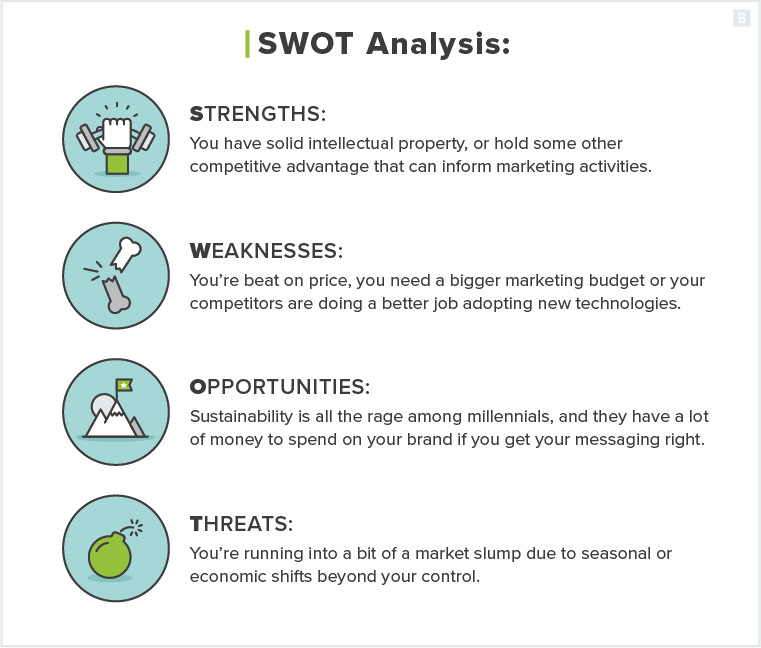
- Strengths: You have solid intellectual property, or hold some other competitive advantage that can inform marketing activities.
- Weaknesses: You’re beat on price, you need a bigger marketing budget or your competitors are doing a better job adopting new technologies.
- Opportunities: Sustainability is all the rage among millennials, and they have a lot of money to spend on your brand if you get your messaging right.
- Threats: You’re running into a bit of a market slump due to seasonal or economic shifts beyond your control.
Clearly, a circumstance that’s a threat to one brand can be an opportunity for another.
And that’s the whole point of this exercise. It helps you identify your strengths and weaknesses in your target market. From here, you can start forming the short- and long-term goals of your marketing strategy – whether that’s to play up your strengths or bolster your weaknesses. A thorough competitive analysis at this stage can provide insights into how to gain market share and outperform your competitors.
fundamentals of email marketing or social media marketing since we’ve done that elsewhere on this blog.
For the sake of your marketing plan, just know this: Practically any long-term marketing goal you can name will require some combination of the channels listed above.
And deciding which channels to use for content creation, distribution and promotion (based on your goals) is a whole lot easier when you have a bit of help from a digital marketing expert. Integrating marketing automation into your strategy can significantly enhance the efficiency of your marketing activities, allowing your marketing team to focus on more strategic tasks.

The marketing X-factor: Dedication

Specifically, dedication to doing what works as opposed to what seems easy or convenient.
I’ll be brutally honest: There is no “easy way out” of marketing. It requires attention to detail, some trial and error, and, of course, a well-thought-out plan.
And when you’re willing to produce all of that, the results speak for themselves.
Editor’s Note: Updated April 2024.
#Components #Marketing #Plan #Succeed #Brafton