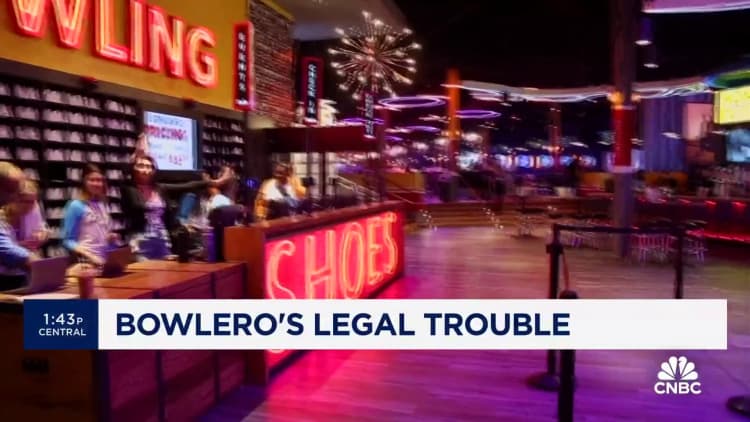
A former executive at Bowlero, the world’s largest owner and operator of bowling centers, has asked a court’s permission to countersue his former employer for extortion and retaliation, after an executive on a recorded call threatened to report him to the FBI if he didn’t admit to spilling company secrets, according to a transcript of the conversation filed in court.
The allegations by Bowlero’s former chief information officer, Thomas Tanase, filed Wednesday in a proposed countersuit in Virginia federal court, come after he and dozens of others filed discrimination claims with the U.S. Equal Employment Opportunity Commission alleging they were fired based on their age or out of retaliation, according to company securities filings and the proposed countersuit. Bowlero denies the claims.
The company, which went public in late 2021 through a special purpose acquisition company, or SPAC, was among the select successful stocks to emerge from the SPAC boom. It owns two of the biggest brands in bowling — AMF and Lucky Strike — and operated more than 300 bowling centers across North America as of July. Between 2021 and 2023, Bowlero nearly tripled its annual revenue, from $395 million to $1.06 billion, and it expects sales to grow between 10% and 15% in fiscal 2024, according to company filings.
Tanase started with the company’s information technology department in 2001 before climbing his way up to the C-suite, where he worked closely with the company’s CEO and frequently had access to sensitive information contained in the CEO’s email accounts, he said in court filings. He says the company fired him in May because of his age, and in August, he filed a discrimination claim with the EEOC, according to a copy of the claim, which was included as an exhibit to the proposed countersuit.
Bowlero says that Tanase resigned and then had a change of heart when he realized he wouldn’t get severance pay. In July, the company sued him, alleging he hacked into the email account of CEO Thomas Shannon, copied company documents onto a personal USB drive and refused to hand over his company-issued devices. Tanase denies the claims.
Now, Tanase is seeking the court’s permission to countersue Bowlero and the company’s executive vice chairman, Brett Parker. Federal rules require Tanase to get permission to countersue given the timing of the filings.
In the proposed countersuit, Tanase alleges that Parker threatened to report him to the FBI if he didn’t admit to accessing Shannon’s emails and “come clean” about information he shared with Daniel Dowe, the attorney representing the EEOC complainants, and with CNBC, which has previously written about the discrimination allegations against Bowlero. During a March deposition, Tanase testified that he hadn’t spoken with CNBC, or any other media outlet, about the company.
embroiled in an EEOC investigation since 2016 involving more than 70 former employees who claim they were unlawfully fired. They allege that Bowlero fired them for being too old as it worked to transform its hundreds of locations from what the company has referred to as “dingy” bowling alleys to upmarket experiences with elevated food and drink offerings.
Complaints and an affidavit filed by three former employees, including Tanase, say Shannon hosted “beauty contests” with prospective hires over brief video calls to evaluate a candidate’s appearance as part of the hiring process.
Tanase’s complaint accused Shannon of making “racial and especially inappropriate ‘blonde women’ jokes” and “always treated wom[e]n as an inferior class to men.” Tanase also alleged that the company’s policies banning Timberland boots and ball caps worn backward were “designed to deter African American males from using” the company’s bowling centers.
The EEOC has found reasonable cause in the majority of the complaints brought against Bowlero, including Tanase’s, while the rest remain under investigation, according to Tanase’s complaint and company reports. When the EEOC finds reasonable cause in a complaint, it means it believes discrimination occurred.
The EEOC previously tried to settle the complaints with Bowlero for $60 million in January 2023, but those efforts failed last April, CNBC previously reported. The agency now has the ability to file a federal lawsuit against the company, but it’s unclear if it will. Before the agency can sue Bowlero in federal court, the EEOC’s commissioners need to vote on the matter.
Spiro, Bowlero’s attorney, told CNBC the employment discrimination claims “are without merit.”
“The so-called eeoc issues are age based discrimination claims, some of which date back to nearly a decade ago and no civil nor eeoc suit has ever even occurred with respect to those claims,” Spiro wrote in an email.
Pickus, Tanase’s attorney, said the EEOC’s reasonable cause findings that Bowlero engaged in discriminatory practices dating back to 2013 “would seem to belie Mr. Spiro’s assertions” that his client’s counterclaims are “frivolous.”
“Those findings by the EEOC may well be why Bowlero has sued Mr. Tanase. Bowlero’s actions remind me of a sports cliche: the best defense is a good offense,” Pickus added.
“We look forward to proving both claims,” he said.